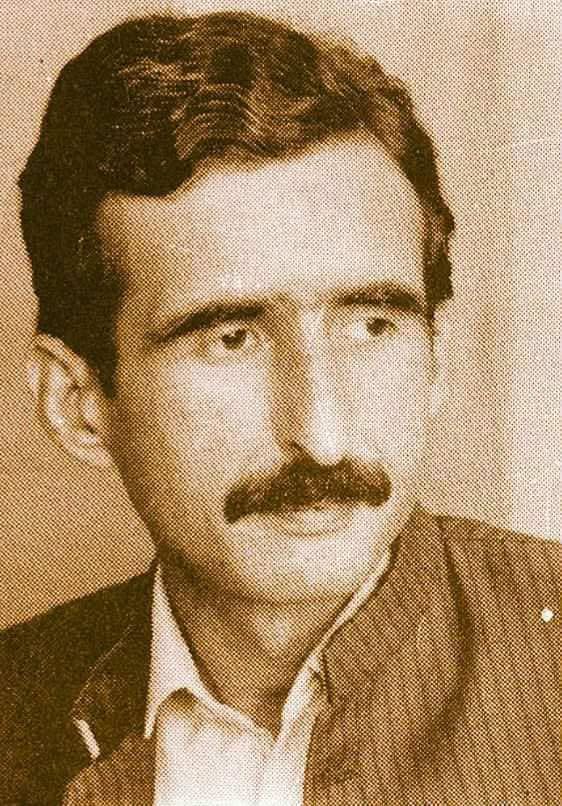
Maqbool Amir
Maqbool Amir was a distinguished name in Urdu poetry who, despite leaving this world at a young age, achieved immortality through his remarkable literary contributions. His real name was Syed Maqbool Hussain Shah, but in literary circles, he became widely known by his pen name, Maqbool Amir. He was born in 1954 in Jhando Khel, Bannu, Pakistan. He belonged to a spiritual and scholarly family. His father, Amir Abdullah, served as a headmaster in a local school and passed away in 1990. Maqbool Amir completed his matriculation from Government High School No. 2, Bannu, in 1970 and later completed his F.Sc. In 1975, he earned a Bachelor's degree from Gomal University. Initially, he enrolled in an M.A. program in English Literature, but due to professional commitments, he could not complete it. Later, he obtained an M.A. in Urdu from University of Peshawar. He began his career with Habib Bank Limited. Because of his deep passion for literature, he arranged a transfer to Peshawar to remain in close contact with poets and writers. He also appeared for an interview for a lecturer's position but was unsuccessful. Eventually, in 1984, he joined the Pakistan Academy of Letters in Islamabad as a Research Officer, where he remained associated until his death. Maqbool Amir's only poetry collection, The Eye of the Lamp (Diye Ki Aankh), was published in 1990 in Islamabad. The collection includes ghazals, poems, and other literary works characterized by emotional depth, romantic expression, and a profound love for his homeland. Renowned literary figure Ahmad Nadeem Qasmi wrote that although Maqbool Amir was a Pashtun and Pashto was his mother tongue, and his Pashtun accent was evident when he spoke Urdu, his poetry was written in exceptionally pure and fluent Urdu, enriched with deep emotions and imagination. According to Qasmi, it was astonishing that this Pashtun poet from Bannu could write in a style reminiscent of masters like Firaq Gorakhpuri and Yagana Changezi, while still maintaining his own unique poetic identity. Due to the popularity of this collection, Tariq Mahmood Danish translated it into Pashto verse in 2008 under the title Da Dewe Sterge (The Eyes of the Lamp). Today, the original book has become nearly impossible to find. In his youth, Maqbool Amir was diagnosed with Scleroderma, a rare and painful disease that caused the skin and fingertips to harden. He even traveled to London for treatment, but unfortunately, his condition did not improve. On May 13, 1990, he suffered a heart attack and passed away the following day. He was laid to rest in his ancestral village of Jhando Khel, Bannu. He was only 36 years old. The following famous couplet is inscribed on his grave: "I have died on the battlefield of loyalty, O Amir; even in defeat, my dignity remains intact." Among his memorable verses are: "For the people of the night, it is a promise of dawn; there are no tears in the eye of the lamp—only light." "Someone is departing forever from this life; if only time could pause for just a moment." Research dissertations on the life and literary contributions of Maqbool Amir have been completed at both the Master's and M.Phil. levels, including studies conducted at the University of Peshawar and Allama Iqbal Open University. These scholarly works testify that, despite his short life, Maqbool Amir secured a permanent and respected place in the world of Urdu literature. May Allah elevate his ranks and grant him eternal peace. Ameen.
Maqbool Amir earned a permanent and respected place in Urdu literature through his acclaimed poetry collection Diye Ki Aankh and his lasting literary legacy.